


High-quality sweets are identified by checking for pure ingredients, a natural aroma, and a clear best-before date on the pack. You should look for sweets made with real dairy, pure ghee, and natural sweeteners. Avoid products containing artificial food colors, synthetic flavors, or excessive chemical preservatives.
Have you ever bought a box of treats and felt disappointed by the taste? It happens all the time in the food industry.
The global confectionery market is worth over 300 billion dollars. Sadly, many commercial products do not meet high standards. You need to know exactly what goes into your food. Recognizing the difference between premium treats and cheap alternatives helps you choose well. It also ensures you get full value for your money.
Let’s look at the hard facts about sweet production.
What Ingredients Show True Sweet Quality?
Look for items made with milk, fresh nuts, and real ghee instead of cheap vegetable oils. Artisanal sweets use natural sugars or raw jaggery rather than high-fructose corn syrup.
Reading the nutrition label is your best defense against poor quality. High-quality makers list simple, recognizable items on their packaging. They do not hide behind complex chemical names. Here are 4 ingredients that indicate a premium product:
- Ghee: This traditional clarified butter provides a rich, classic flavor profile.
- Real Dairy: Fresh milk and khoya (reduced milk solids) create a rich base.
- Natural Colors: Real saffron gives a distinct yellow tint. Crushed pistachios add a natural green hue.
- Whole Nuts: Premium makers use whole almonds and cashews rather than artificial nut extracts.
Many commercial brands use palm oil or hydrogenated vegetable oils to cut their production costs. Palm oil alters the food’s physical structure. It leaves a greasy, unpleasant coating in your mouth. Always check the ingredient list for pure, natural fats.
How Does Texture Reveal Freshness and Quality?
The physical texture of a sweet indicates its freshness and preparation method.
High-quality milk-based sweets should break apart cleanly and feel soft.
Hard, crumbly, or overly chewy textures often signal stale ingredients or the use of unnatural binding agents.
Touch tells you a massive amount about food preparation. Fresh treats have a distinct, soft feel. When you press a fresh milk sweet like a peda or barfi, it yields easily under slight pressure. Stale sweets lose their moisture content over time. They become dry and hard around the outer edges.
If a dairy-based sweet stretches like rubber, it likely contains chemical binders or cheap starch fillers.
Pure ingredients react naturally to temperature changes. Real butter and pure ghee melt completely at human body temperature. Fake, hydrogenated fats do not melt easily and require more chewing.
Short or Long Shelf Life: What Does It Really Tell You?
For loose sweets sold from a counter, a short shelf life is normal. Milk sweets such as penda, kalakand or mawa barfi are best within a few days and belong in the fridge. But a long best-before date on a sealed pack does not mean poor quality. Modern packaging now lets well-made sweets last for weeks.
Sweets go off mainly because of oxygen and moisture. Packed sweets are protected from both, which is why sealed packs of kaju katli, dry fruit sweets and barfi can carry best-before dates of around 20 to 60 days, and some dry fruit boxes even longer. These are the main methods:
- Modified Atmosphere Packaging (MAP): the air inside the pack is replaced with a food-grade gas, usually nitrogen, sometimes with a little carbon dioxide. With very little oxygen left, ghee and nuts do not turn rancid as quickly, and mould struggles to grow.
- Nitrogen flushing: the most common form of MAP, also used for chips and namkeen. Nitrogen makes up about 78% of the air we breathe.
- Vacuum packing: the air is drawn out before the pack is sealed.
- Barrier films and oxygen absorbers: multi-layer packaging and small sachets inside the pack block or soak up any oxygen that is left.
- Retort processing: the sweet is sealed in a pouch or tin and then heated under pressure, much like canning. This keeps it shelf-stable for months. Tinned gulab jamun and rasgulla are made this way.
Are packed sweets safe? Yes, when the pack is made and stored properly. These methods work by controlling the air, moisture and heat around the food. Nitrogen (INS 941) and carbon dioxide (INS 290) are food-grade packaging gases permitted for food use in India. Every packed sweet must show a best-before or use-by date, set by the maker after shelf-life testing.
The protection lasts only while the pack is sealed and stored as the label says. Once you open it, treat it like a loose sweet: keep it in an airtight box and finish it within a few days. Do not buy a pack that is puffed up, torn or past its date.
At Radhe Prem Ni Mithaas we use MAP and nitrogen flushing, vacuum packing, barrier films with oxygen absorbers, and retort packing for our packed range, and every pack shows its best-before date. Browse our packed sweets and Diwali gift boxes.
How Can You Test the Aroma of Sweets?
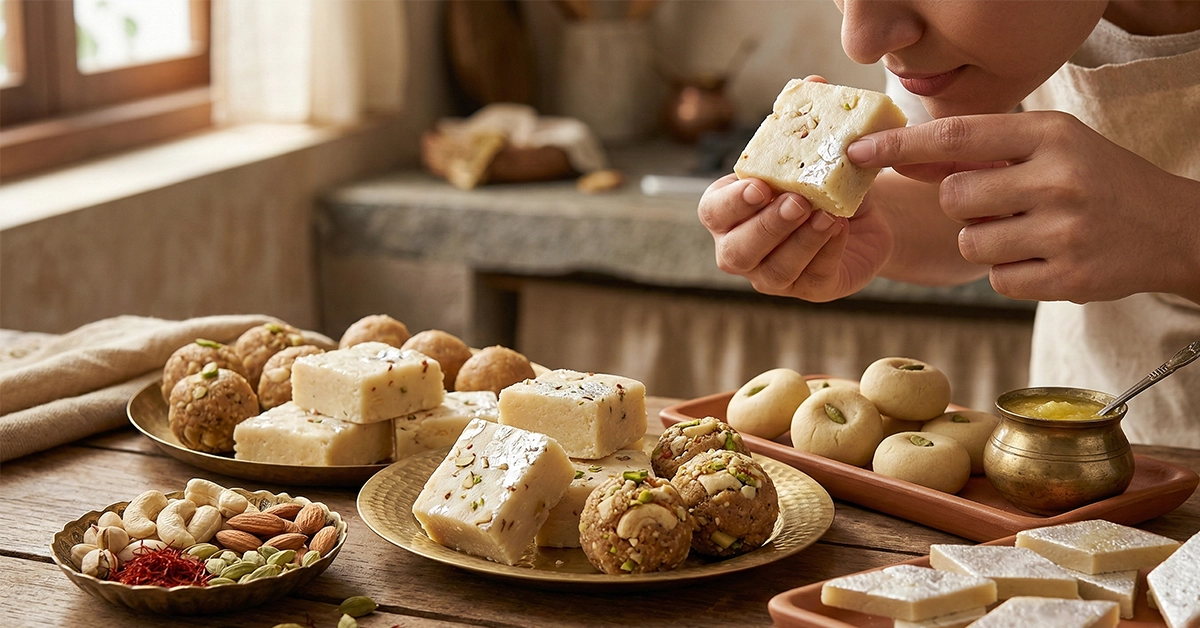
Well-made sweets give off a mild, natural scent derived from their core ingredients like roasted nuts, cardamom, or pure butter. An overpowering, perfume-like smell usually points to the addition of synthetic chemical flavorings designed to mask low-quality base materials.
Smell your food carefully before you take a bite. Your nose can detect fake ingredients faster than your eyes. Natural flavor enhancers like ground cardamom, pure saffron, and real rose water have a very subtle, pleasant scent.
Artificial essences smell incredibly sharp and unnatural. If a strawberry sweet smells exactly like cheap bubblegum, it definitely contains synthetic chemical esters.
High-quality sweets offer a perfectly balanced aroma that matches the actual physical ingredients.
Use these specific testing steps to check your next purchase. Look closely at the ingredients, test the texture, check the expiration date, and smell the product. Doing this helps you pick good-quality treats every single time.