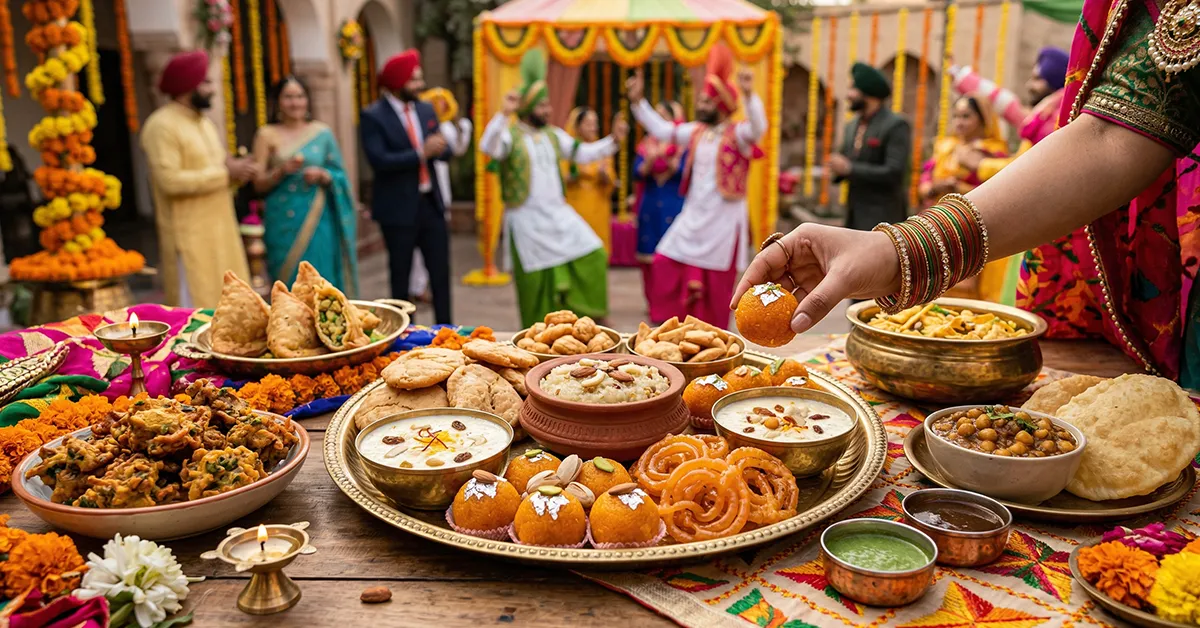
Every year in mid-April, a particular kind of energy fills the air in Punjab and across North India. The wheat is golden in the fields, the days are getting warmer, and Baisakhi is here. It is a festival of abundance, a thanksgiving for the harvest, a new year for many communities, and a day that is celebrated with music, colour, and above all, food.
Baisakhi celebrated on April 13 or 14 every year and marks the solar new year in several Indian traditions. For Sikhs, it also commemorates the founding of the Khalsa Panth by Guru Gobind Singh in 1699. For farmers across Punjab, Haryana, and Himachal Pradesh, it marks the reaping of the Rabi crop.
Whatever the lens, Baisakhi is fundamentally a celebration of the earth’s generosity — and no celebration of that kind is complete without a spread of food.
The Spirit of Baisakhi Food
Baisakhi food is generous, hearty, and deeply rooted in the agricultural traditions of North India. The ingredients that go into Baisakhi dishes (wheat, jaggery, sesame, ghee, mustard) are the same ingredients that the land has just yielded. Eating them on this day is an act of gratitude, a circle completed.
Gurdwaras across the country serve langar on Baisakhi, community meals open to everyone, regardless of background. These langars include traditional dishes made from the season’s harvest.
At home, families prepare special meals, and sweets are an essential part of the celebration.
Traditional Baisakhi Sweets
Meethe Chawal (Sweet Yellow Rice) is one of the most iconic Baisakhi preparations. Rice is cooked with saffron, ghee, sugar, and dry fruits, turning it a beautiful golden yellow. The colour represents the ripening wheat fields, and the fragrance of saffron and cardamom fills the home. Meethe chawal is served at gurdwaras as prasad and prepared in households as a festive dish.
Pinni is a traditional Punjabi sweet made from roasted whole wheat flour (atta), ghee, jaggery, and dry fruits. Dense, nutritious, and deeply satisfying, pinni is a winter sweet that lingers into Baisakhi. Its rich flavour comes from the slow roasting of the wheat flour in ghee — a process that fills the kitchen with an aroma that is almost impossible to resist.
Jaggery-based sweets feature prominently on the Baisakhi table. Gur ke ladoo — round balls of jaggery, sesame, and puffed rice — are both a sweet and a health tonic. Jaggery is considered a warming food in Ayurvedic tradition, ideal for the transitional season between winter and summer.
Kheer is prepared in many Punjabi homes on Baisakhi and distributed as prasad. Slow-cooked rice pudding with milk, sugar, cardamom, and almonds. It is one of those sweets that feels like a blessing in every spoonful. On a festive morning, a bowl of freshly made kheer is among life’s simplest pleasures.
Boondi Ladoo is widely offered as prasad at gurdwaras and temples on Baisakhi. The small, round, ghee-soaked boondi balls pressed into perfectly spherical ladoos are a symbol of celebration across India, and Baisakhi is no exception.
Savoury Snacks of Baisakhi
Baisakhi is not only about sweets. The savoury traditions are equally rich. Makki di roti with sarson da saag is the great Punjabi winter and harvest meal, and it makes its final appearance of the season on Baisakhi. Paired with white butter and jaggery, it is a meal that celebrates the land’s last winter gift.
Amritsari papdi and punjabi mathri are crispy savoury snacks that are packed into tiffins and shared at Baisakhi melas (fairs). These flaky, spiced bites are the perfect accompaniment to the festival’s outdoor energy — easy to carry, satisfying to eat, and full of flavour.
At the famous Baisakhi melas held across Punjab especially in Amritsar and Anandpur Sahib, street vendors set up stalls selling everything from chana masala and jalebi to freshly fried namkeen. The mela is as much a food festival as it is a cultural one.
Gifting Sweets on Baisakhi
Baisakhi is increasingly becoming an occasion for sweet gifting, especially as people living outside Punjab want to share the festive spirit with family and friends. A well-packed box of traditional Indian sweets (boondi ladoo, kaju katli, or a mix of dry fruit sweets) is a meaningful Baisakhi gift that carries the warmth of the festival regardless of distance.
For corporate gifting on Baisakhi, sweet hampers that combine mithai and namkeen varieties are especially popular. They offer something for every palate and present beautifully as a festive gesture to employees, clients, and partners.
A Harvest Worth Celebrating
Baisakhi reminds us that joy comes from the earth, from community, from gratitude. And in the Indian tradition, gratitude always finds its most delicious expression in food, in the sweets shared after the puja, in the langar that feeds everyone, in the box of mithai sent across the country to someone you love.
This Baisakhi, celebrate with the taste of tradition. Prem Ni Mithaas has freshly made ladoos, barfis, and festive hampers ready to order across India. Order now!