


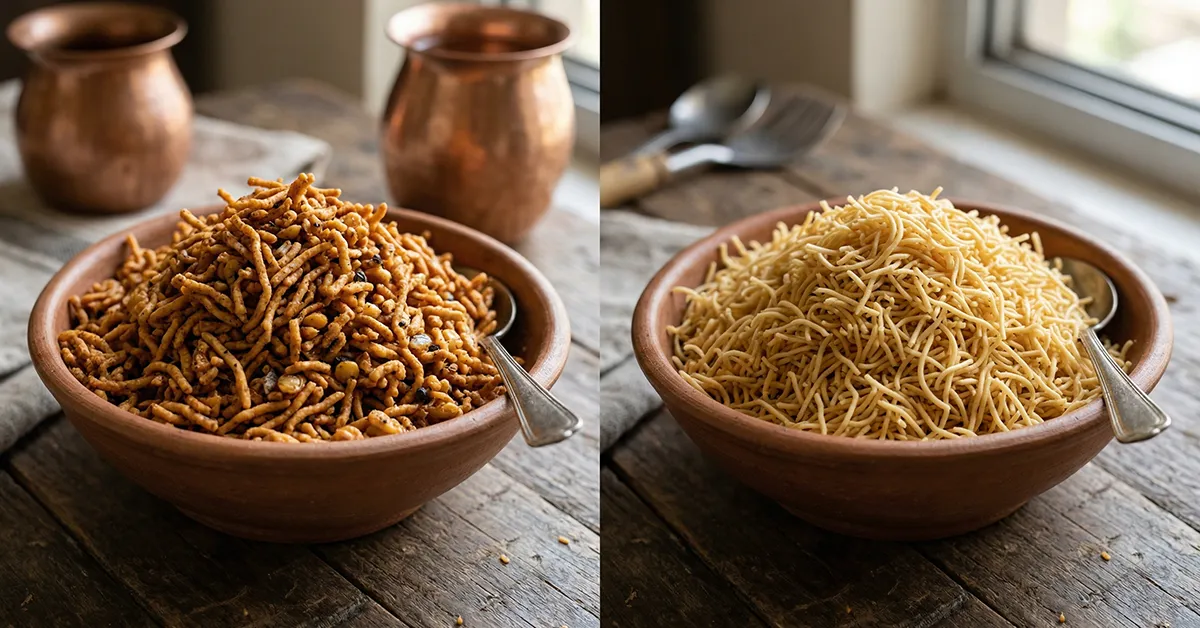
Pick up a handful of bhujia. Now pick up a handful of sev. They look almost identical — thin, golden, fried, and impossible to stop eating. But the moment you taste them side by side, you notice they are two different things entirely. Different flour, different texture, different crunch, different character.
Both bhujia and sev are staples of the Indian namkeen tradition. At Prem Ni Mithaas, we make and sell both — and we get asked about the difference more often than you might think.
Hence we have prepared this guide to explain what each one is, how they are made, where they come from, and when to reach for one over the other.
Let’s get into more details.
What Is Sev?
Sev is a fried Gujarati namkeen made from besan (gram flour) pressed through a mould with small circular holes directly into hot oil. The result is thin, crispy strands uniform in shape, light in texture, and consistently crunchy from end to end. It is one of the most widely made and widely eaten namkeen varieties in India.
The basic ingredients are besan, water, salt, a little turmeric, and oil for frying. Beyond that, the spice level and thickness are where different types of sev split apart.
Fine sev, sometimes called nylon sev is extremely thin, almost feathery, and dissolves quickly on the tongue.
Thick sev has more body and a more satisfying bite.
Both are eaten as snacks on their own, and both show up in Indian cooking in ways that go well beyond the snack bowl.
What Are the Different Types of Sev?
- Nylon Sev (Fine Sev) — The thinnest variety. Extremely delicate, used mainly as a topping on chaats like bhel puri, dahi papdi, and sev puri. Dissolves within seconds on the tongue.
- Thick Sev — Sturdier, with more crunch. Eaten as a standalone snack with tea. Holds its texture in a bowl without going soft quickly.
- Ratlami Sev — Made in Ratlam, Madhya Pradesh. Sharply spiced with black pepper, cloves, and sometimes ajwain. Much more aggressive heat than regular sev. A regional specialty that has gone national.
- Gathiya — A Gujarati version of thick sev with a softer, crumblier bite. Made slightly differently, with more fat in the dough, giving it a less brittle texture. Popular as a chai-time snack across Gujarat.
- Garlic Sev — Sev with garlic paste worked into the dough before frying. Strong, aromatic, and deeply savoury. A popular choice for people who want more flavour than plain sev delivers.
What Is Bhujia?
Bhujia is a fried namkeen from Bikaner, Rajasthan, made primarily from moth bean flour (moth dal) — not plain besan. This is the single most important difference between bhujia and sev. Moth bean is a drought-resistant legume grown widely in Rajasthan, and its flour gives bhujia a slightly rougher texture, a denser bite, and a distinctly earthier flavour than sev made from gram flour alone.
The most famous version is Bikaneri bhujia — made with moth bean flour, besan, black pepper, and a specific blend of spices, fried in oil, and then dried further to achieve that characteristic crumbling crunch. Bikaner has been making and exporting this namkeen for well over a century. What began as a Rajasthani regional product is now eaten across India and recognised internationally.
The flavour of bhujia is noticeably deeper than plain sev. The moth bean brings a subtle nuttiness, the black pepper builds heat slowly rather than hitting all at once, and the spice blend gives it a complexity that is hard to pin down but easy to recognise. One small fistful of bhujia feels more complete — more flavour in fewer pieces.
What Are the Key Differences Between Bhujia and Sev?
Bhujia and sev differ in 4 specific ways: base flour, texture, flavour profile, and culinary use. Sev is made from besan only. Bhujia contains moth bean flour, which changes its texture and taste. Sev comes in long, uniform strands. Bhujia is shorter and more irregular. Sev is lighter and milder. Bhujia is denser and more intensely spiced. Sev is a topping as well as a snack. Bhujia is primarily eaten on its own.
| Feature | Sev | Bhujia |
|---|---|---|
| Primary flour | Besan (gram flour) | Moth bean flour + besan |
| Shape | Long, uniform strands | Shorter, irregular, rough-edged |
| Texture | Light, consistently crispy | Denser, crumbles more when bitten |
| Flavour | Mild to moderately spiced | Deeper, earthier, more complex spice |
| Regional origin | Gujarat (farsan tradition) | Bikaner, Rajasthan |
| Main use | Snack + chaat topping + cooking ingredient | Standalone snack |
| Shelf life | Good in sealed packaging | Good in sealed packaging |
Which One Is Better for Snacking?
Both bhujia and sev work well as tea-time snacks, but they deliver different experiences. Sev is lighter — you can eat more of it without feeling heavy. Bhujia is more filling per handful because of the moth bean flour’s protein density and the richer spice profile.
If you want something you can keep reaching for over a long sitting, sev is the easier choice. If you want a more flavour-forward snack that satisfies quickly, bhujia wins.
For chai pairing specifically, thick sev and gathiya are classic Gujarat companions to morning or afternoon tea. Bhujia pairs equally well but brings more heat, which some people prefer and others find too intense early in the morning.
Which One Works Better in Cooking and Chaat?
Sev is the clear winner here. Fine sev is a core ingredient in dozens of Indian recipes and street foods — bhel puri, sev puri, dahi papdi chaat, sev tamatar, and Gujarati dishes like sev khamani all rely on it.
The thinness of nylon sev lets it absorb moisture from chutneys and yogurt while still adding crunch in the first few bites.
Bhujia is not typically used as a cooking ingredient or chaat topping in the same way. Its flavour is too assertive and its texture too irregular to function well as a garnish.
There are exceptions — a sprinkle of fine bhujia over certain Rajasthani dishes is a traditional touch — but in general, if a recipe calls for sev, use sev. Bhujia will not substitute cleanly.
Which One Is Better for Gifting?
Neither one alone. The best namkeen gift box includes both — along with 2 or 3 other varieties — so the recipient gets the full picture of Indian savoury snacking.
A well-put-together namkeen hamper with sev, bhujia, mathri, chivda, and perhaps a packet of Ratlami sev or masala khakhra covers every preference and every craving.
Both sev and bhujia travel well in sealed packaging. Shelf life for most well-made namkeen is 25–30 days, which makes them practical for pan-India shipping. If you are ordering a namkeen gift box from Prem Ni Mithaas for someone in another city, it will arrive fresh and intact without any special handling.
For corporate gifting, a namkeen assortment often works better than a sweet box — it is more inclusive across dietary preferences and feels less heavy after a meal. Bhujia and sev, together in a branded tin, make a genuinely thoughtful corporate Diwali or New Year gift.
Does the Region You Are From Change Which One You Prefer?
Quite often, yes. People who grew up in Gujarat typically grew up eating sev in its many forms — it is woven into the state’s food culture at every level, from street chaat to home kitchens to festive farsan boxes. For them, sev is the default namkeen.
Bhujia might feel more intensely spiced than they are used to.
People from Rajasthan and North India often have the opposite relationship — bhujia is what they grew up with. It was in the tin on the kitchen shelf, it was what came out with tea, and its particular heat and earthiness feels like home.
For them, plain sev can feel mild and a little one-dimensional by comparison.
The good news is that both are available nationally and both are loved broadly across India today. Regional loyalty is real, but it has never stopped anyone from enjoying both.
What Does Prem Ni Mithaas Offer in Sev and Namkeen?
At Prem Ni Mithaas, we make over 50 varieties of namkeen and savoury snacks, all produced fresh. Our range covers the full Gujarati farsan tradition: gathiya, khakhra, fafda, bhakharwadi, sev varieties, chivda, and more. We also stock bhujia and Ratlami sev for customers who want that sharper, more intense spice profile.
Everything ships pan-India with 5–6 working day delivery from Gandhinagar. Orders placed before 1:00 PM are dispatched the same day. Shelf life on all namkeen is 25–30 days from production, so what you receive is genuinely fresh.
If you are putting together a namkeen gift box or just want to stock your own kitchen with something better than what is available locally, the Prem Ni Mithaas namkeen range is a good place to start. You can mix and match — a little sev, a little bhujia, a packet of masala khakhra — and build the exact box you want.
Bhujia or Sev — Do You Have to Pick Just One?
You do not. And honestly, the best namkeen bowls always have both. Sev brings lightness and versatility. Bhujia brings depth and satisfying heat. Together, they cover more ground than either one does alone.
The question of which one to pick only matters when you are genuinely restricted to one — a single-serve packet, a specific recipe that needs a particular ingredient. In every other situation, the answer is both. India made room for both for a reason.