


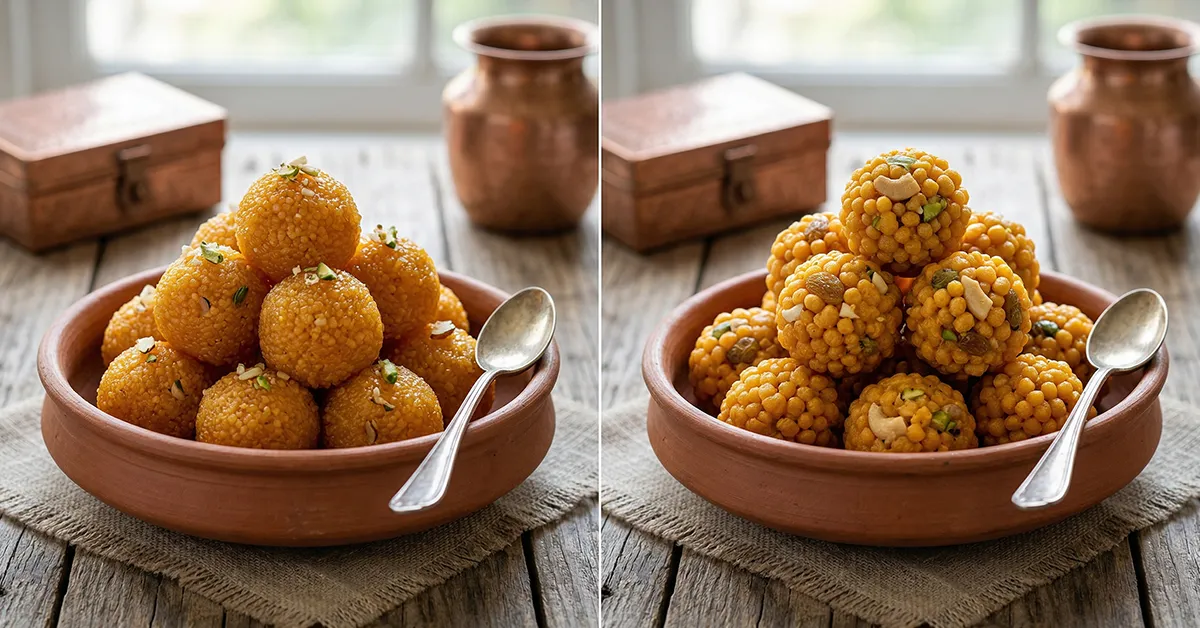
Two golden spheres. Same size, same shine, same counter. You point at one, the sweet shop person picks it up, and you are suddenly not sure if you got the right one. Was that the motichoor? Or the boondi?
This happens to a lot of people. Motichoor ladoo and boondi ladoo genuinely look alike from a distance. But the moment you bite into one, the difference is obvious. Different boondi size, different texture on the tongue, different moisture level, different spice character, different occasions where each one belongs.
At Prem Ni Mithaas, we make both and we get asked to explain the difference by customer more frequently. So here is the detailed comparison.
What Is Motichoor Ladoo?
Motichoor ladoo is made from extremely fine boondi, tiny droplets of besan batter fried through a very fine-holed ladle until they are just cooked, then soaked in sugar syrup and pressed together into a round shape before they cool.
The name itself tells you what to expect: “moti” means pearl, “choor” means fine or crushed. These are pearl-fine boondi, bound by syrup into a soft, cohesive ball.
A well-made motichoor ladoo has almost no visible individual boondi. The pieces are so small and so thoroughly soaked in syrup that they meld together into one smooth, moist mass. The outside has a slight skin without a crust, just a very thin dried layer and the inside gives way gently when pressed.
Motichoor ladoos are typically saffron-orange – a warm, slightly vivid colour that comes from food colour or natural kesar. Pistachio slivers and melon seeds pressed into the surface add a small crunch that contrasts with the soft interior. That contrast, the faint crunch of the garnish against the give of the ladoo is part of what makes a good motichoor so satisfying.
Making of motichoor is genuinely a skilled work.
The boondi must be fried at the right oil temperature so it stays tender rather than turning crisp. The sugar syrup must be at exactly the right consistency — too thin and the ladoos will not hold their shape, too thick and they will seize up before they can be pressed. And the shaping has to happen fast, while the mixture is still warm and workable.
What Is Boondi Ladoo?
Boondi ladoo uses larger boondi — distinct, individual spheres that keep their shape even after being soaked in syrup and pressed together. In boondi ladoo, boondi stays visible. You can see the individual pieces. You can feel them separately when you bite in.
The result is a firmer, denser, more textured ladoo. Each bite has a slight pop — the boondi pressing against your teeth before giving way. The chew is more present than with motichoor. The sweetness is slightly more upfront, less subtle.
Boondi ladoos come in two main versions. The plain sweet version is boondi soaked in sugar syrup, pressed into rounds, sometimes with a raisin or cashew pressed in. The spiced version — sometimes called prasad ladoo — has cardamom, cloves, and occasionally black pepper worked into the mix, along with raisins and cashews.
The spiced version is what you receive at temples across India. It is slightly darker in colour, more aromatic, and carries warmth from the spices that lingers after the sweetness fades.
Boondi ladoos hold together better than motichoor. They can be stacked, carried, and stored for longer without losing their shape or quality. This practical durability is a big reason why boondi ladoos get made in large batches for community events, temple distributions, and weddings where thousands of pieces need to be prepared in advance.
What Are the Key Differences Between Motichoor and Boondi Ladoo?
Motichoor and boondi ladoo differ across 5 characteristics: boondi size, texture, moisture level, flavour profile, and how long they stay fresh. Motichoor uses micro-fine boondi that nearly dissolves into the ladoo. Boondi ladoo uses larger pearls that retain their individual shape. Motichoor is softer, moister, and more delicate. Boondi ladoo is firmer, drier, and sturdier. Their ideal uses and storage windows are also different.
| Feature | Motichoor Ladoo | Boondi Ladoo |
|---|---|---|
| Boondi size | Extremely fine — almost invisible in the finished ladoo | Larger — individual pearls visible and felt when eaten |
| Texture | Soft, moist, melts on the tongue | Firmer, denser, slight pop when bitten |
| Colour | Warm saffron-orange | Golden to light amber |
| Flavour | Delicate — saffron, cardamom, subtle sweetness | Sweeter upfront, spiced version has cardamom and clove |
| Shelf life | 2–3 days at room temperature ideally | 5–7 days when stored properly |
| Best occasion | Gifting, celebrations, weddings, Diwali | Prasad, bulk distribution, temple offerings, weddings |
| Skill to make | Higher — timing and temperature critical | More forgiving — holds up better through the process |
Which One Tastes Better?
This is the wrong question — but it is also the most asked one, so it deserves a direct answer. Motichoor ladoo tastes more refined. The flavour is gentler, the texture more luxurious, and when it is made fresh and well, it is one of the most pleasurable bites in all of Indian mithai.
Boondi ladoo tastes more satisfying in a different way — heartier, more substantial, with a sweetness that is less subtle and a texture that gives your teeth something to work against.
If you are eating one ladoo slowly and paying attention, motichoor wins on elegance. If you are eating three ladoos quickly, boondi holds its own completely.
Which One Is Better for Gifting?
Motichoor ladoo is the first choice of many indians as a gifting sweet. Its appearance — smooth, glossy, saffron-orange, decorated with pista and melon seeds indicates care and quality. It is the ladoo people associate with premium mithai, with a box brought to someone’s home for Diwali or a wedding, with a gesture that says the giver thought about what they were giving.
The one drawback for gifting is shelf life. Motichoor ladoos are best eaten within 2–3 days of being made. If you are sending sweets across India by courier, motichoor is not the safest choice — 5 days in transit will push them past their best. For long-distance gifting, boondi ladoos travel significantly better and arrive in good condition.
For in-person gifting — a box you are carrying to someone’s home, a return gift at a puja, sweets for a guest list in the same city — motichoor is the obvious choice.
For pan-India delivery, go with boondi ladoo.
Which One Is Better for Prasad and Temple Offerings?
Boondi ladoo. Without question. The spiced prasad boondi ladoo — with cardamom, cloves, raisins, and cashews — is the standard temple offering across India. Tirupati’s famous prasadam is a boondi ladoo. Ram Navami distributions are boondi ladoos. Satyanarayan puja prasad is almost always boondi ladoo.
The reasons are obvious: these ladoos can be made by the hundreds, hold their shape through handling, and stay good for several days without refrigeration.
Motichoor ladoo is also offered as prasad — particularly at Ganesh temples and at smaller home pujas where a more delicate presentation is appropriate. But when quantity, durability, and broad distribution are the requirements, boondi ladoo is what gets made.
Which One Should You Order When Buying Online?
Order based on what you are going to do with the ladoos, not just on which one you prefer to eat.
- Buying for yourself or in-home celebration — Order motichoor. Eat within 2–3 days. The freshness makes a real difference.
- Buying to gift to someone in your city — Motichoor works well if delivery is same-day or next-day. Call ahead so they know to have it out at room temperature, not in the fridge.
- Buying to ship across India — Choose boondi ladoo. The 5–7 day shelf life comfortably covers the 5–6 working day delivery window that most pan-India orders take.
- Buying for a puja or large event distribution — Boondi ladoo is the practical choice. Make sure you order at least 3–4 days in advance if quantities are large.
- Buying for a gift box with other sweets — Include both. One motichoor and one boondi in the same box gives the recipient both experiences, and an assorted box always feels more generous than a single variety.
How Does Prem Ni Mithaas Make Its Ladoos?
At Prem Ni Mithaas, both ladoos are made fresh daily. We have been making traditional Indian mithai for over 75 years, and the production process has not changed in the ways that matter: the boondi is fried in pure ghee, the sugar syrup is made fresh for each batch, and the shaping happens by hand while the mixture is still warm.
Our Motichoor Ladoo is made with fine boondi, natural saffron colour, and cardamom — pressed by hand and garnished with pista and melon seeds. It is a same-day product. We make it fresh and it goes out fresh.
Both varieties are available for pan-India delivery through premnimithaas.com, with same-day dispatch for orders placed before 1:00 PM and 5–6 working day delivery across India.
For motichoor specifically, we recommend choosing expedited delivery or ordering close to the occasion date for maximum freshness on arrival.
In brief, if you are genuinely restricted to one — one variety for a puja, one ladoo per guest, one type to ship across India — now you know exactly which one to pick and why.