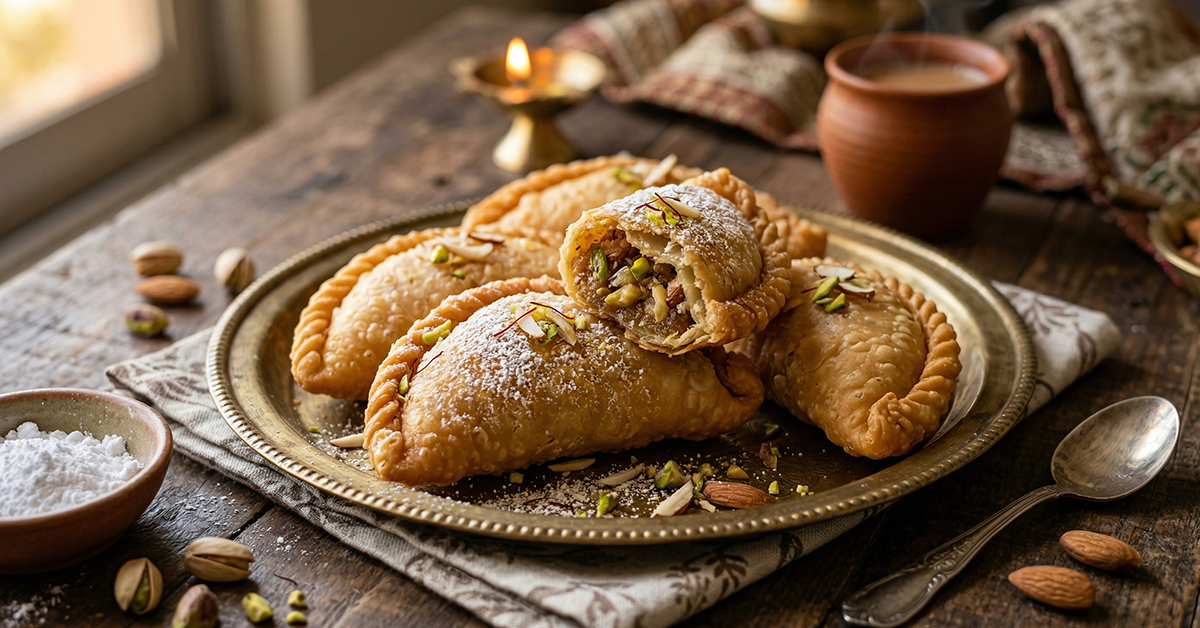
There is a sweet in India that carries the entire spirit of spring in its crescent-shaped, ghee-soaked body. Gujiya — the fried, stuffed dumpling filled with khoya, sugar, dry fruits, and coconut is one of those sweets that belongs deeply to its festival, to its season, and to the specific joy of making something with your hands alongside the people you love.
Holi, the festival of colours celebrated in March, is the occasion most associated with gujiya. But this beautiful sweet transcends the festival. It appears at Diwali in some regions, at weddings in others, and on ordinary spring afternoons in homes where tradition is observed with love and flour-dusted hands.
What is Gujiya?
Gujiya (also spelled gujhiya, or called karanji in Maharashtra, or kajjikayalu in Andhra Pradesh) is a deep-fried pastry made from maida (refined wheat flour) dough, shaped like a half-moon, and filled with a mixture of sweetened khoya (reduced milk solids), sugar, cardamom, dry fruits, desiccated coconut, and sometimes semolina. The edges are crimped decoratively before frying — a step that is both functional (sealing the filling) and aesthetic (creating the distinctive ridged border that gujiya is recognised by).
The frying is done in ghee or clean oil at a medium temperature slow enough that the pastry cooks through without burning, hot enough to achieve the light golden colour that characterises a well-made gujiya. A good gujiya has a crisp, shattering exterior and a sweet, soft, fragrant filling that contrasts perfectly with the pastry shell.
The History and Regional Significance of Gujiya
Gujiya has been made in Indian homes for hundreds of years. Its origins are associated with North India, particularly Mathura, Vrindavan, and the broader Braj region of Uttar Pradesh, where Holi is celebrated with extraordinary fervour and gujiya is its official sweet. The city of Mathura, birthplace of Lord Krishna, is particularly famous for its gujiya, which is made in vast quantities and distributed to devotees and visitors during Holi week.
In Rajasthan, gujiya is made for Holi and Diwali both, sometimes with slight regional variations — more dry fruit, a different spice blend, or a coating of sugar syrup that gives the finished sweet a crystallised glaze. In Maharashtra, the karanji version is similar but often contains fresh coconut rather than khoya, reflecting the coastal availability of the ingredient. In Bihar and Jharkhand, a version made with chana dal and jaggery fills the same cultural role.
What unites all of these regional variations is the act of making them. Gujiya is not a sweet you buy casually or at least, traditionally it was not. It is a sweet you make at home, in large batches, over several hours, with family members taking turns at different stations: rolling the pastry, spooning the filling, crimping the edges, watching the oil. The production of gujiya is as much a celebration as the eating of it.
Gujiya and Holi: Why They Belong Together
Holi is a festival of colour, spring, and the end of winter. The timing of gujiya in this context is perfect. Khoya — the base of the traditional gujiya filling is a rich, warming ingredient. Combined with dry fruits and cardamom in a fried pastry, gujiya is the kind of food that is suited to the transitional weather of March: warm enough to feel festive, rich enough to feel indulgent, and made from ingredients that were traditionally available at the end of winter before the summer scarcity set in.
On Holi morning, after the colours have been applied and the water fights are over, the Indian household returns to the kitchen. Thandai, the spiced, chilled milk drink associated with Holi is served alongside gujiya, and the combination is one of the great pairings in Indian festive food culture. The cold, aromatic thandai and the rich, warm gujiya complement each other in a way that has been appreciated for generations.
Modern Variations of Gujiya
The classic khoya-filled, fried gujiya remains the gold standard, but the sweet has evolved.
Baked gujiya versions are lighter, with a more biscuit-like exterior which have become popular among health-conscious consumers.
Chocolate gujiya, with a cocoa-infused filling, has found a following in urban markets. And sugar-syrup soaked gujiya coated in a thin crystallised glaze after frying which is a popular modern variation that adds a sweet crunch to the exterior.
These variations are welcome additions to the gujiya tradition. They make the sweet accessible to new audiences and allow it to evolve without losing its essential character. But for those who have grown up with the classic fried version the one made by a grandmother or an aunt who knows the filling and the frying by instinct, no variation quite matches the original.
Gujiya as a Gift
A box of freshly made gujiya is a Holi gift of genuine thoughtfulness. It communicates that the giver understands the season, knows the tradition, and chose something meaningful over something convenient. While gujiya has a shorter shelf life than dry sweets like kaju katli, ideally consumed within 3–4 days. This is also part of its appeal. It is a seasonal, perishable joy, and receiving it feels like being included in a celebration.
For Holi gifting, pair a small box of gujiya with a selection of other traditional Indian sweets for a hamper that captures the full flavour of the festival. The combination of the warm, fried richness of gujiya with the delicate sweetness of kaju katli or peda creates a gift that tells the complete story of Indian spring celebrations.
Craving authentic Indian mithai? Prem Ni Mithaas brings you freshly made gujiyas, ladoos, barfis, and more — packed with tradition and delivered across India. Order Indian Sweets Online at Prem Ni Mithaas.